
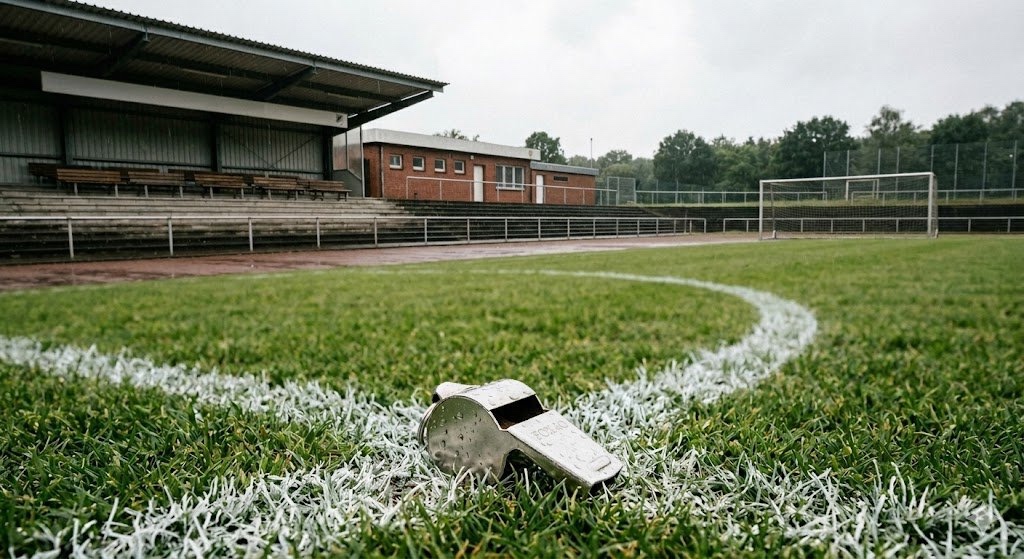
The ball rolls again the day after tomorrow. World Cup 2026, hosted by Mexico, the United States and Canada. When the hosts kick off against South Africa in Mexico on Saturday, I will not be watching the players first. I will be watching the men in black - and over the course of the tournament, one in particular: Szymon Marciniak.
Polish, born 1981, started out on a small-town district pitch in Płock. Today he is a two-time World Referee of the Year, the man who blew the final whistle in Qatar 2022 and Istanbul 2023, and very likely the man who will officiate the final this July.
I watch Marciniak because I held the whistle myself, from the age of fourteen to thirty. Top tier of amateur football in Hamburg, Sunday after Sunday. Marciniak has not taught me anything I did not already learn on rainy Hamburg pitches. But when I watch him, I recognise a signature I know - one that has nothing to do with trophies. It is the same signature I later carried into Shenzhen as a plant manager, into Beijing as a VP Operations, and today into every interim mandate.
People from every walk of life, one game
On those Hamburg pitches I stood in front of lawyers and dockworkers, students and shift workers, kids from St. Pauli and businessmen from Blankenese. On the pitch we were twenty-two players and one referee, and we all wanted the same thing: a game that worked.
That connects people. Not because they suddenly think alike, but because for ninety minutes they share a single goal. I learned to take every person seriously, regardless of what they did off the pitch. I carry that attitude into every shop floor and every mandate.
Leading without standing in the middle
You can tell a good game by the fact that nobody is talking about the referee afterwards. When the official stays invisible, he has done his job.
This is leadership in its most honest form: leading without standing in front. The stage belongs to the players. A leader who insists on being seen at all times has not yet understood the job. Humility here is not a modesty ritual; it is a working principle. It keeps the room clear for the work of others.
One mistake doesn't fix the next
The hardest lesson came early. A young referee - I was perhaps sixteen - blows a foul in the first half that wasn't a foul. The fouled player protests, the bench protests, the stands protest. In the second half, a tackle goes in near the edge of the box, and the inner voice says: Let this one go. Even it out.
That is the trap. Two mistakes do not cancel each other out. They add up. And the game knows it - the players first, the benches even faster.
A mistake is a mistake. The next call is the next call. You have to be able to separate the two.
It is no different in a mandate. Anyone who has made a wrong call - on a layout, a supplier switch, a personnel decision - and then tries to compensate with the next decision rarely creates healing. Most of the time he creates a second wound. Maturity means letting a mistake stand as a mistake, naming it, and then letting the next decision stand on its own feet.
Consistency is not harshness. Empathy is not leniency.
There is a widespread mistake that goes like this: a good referee, a good leader, must be empathetic - and being empathetic means being lenient. Both halves of that sentence are wrong.
Consistency does not mean being hard. It means the rule still applies when applying it is inconvenient. Empathy does not mean letting things slide. It means understanding why someone tackles, shouts, protests - and blowing the whistle anyway.
That is the craft: enforcing the rule deliberately, without diminishing the person. The yellow card with a gesture that says "That's it - but we'll get this back on track now." The quiet word at the player's ear that does not punish, it corrects. Whoever masters this gets something that cannot be forced: authority without volume.
Respect knows no hierarchy
On the pitch I stood in front of lawyers and dockworkers, students and shift workers, club officials and reserve players who had been waiting years for their first start. On the shop floor today, I stand in front of the plant manager and the machine operator, the quality engineer and the warehouse hand. The spectrum in front of me is not one any training course could have invented.
What I learned on those Hamburg pitches: every one of them delivers something I cannot deliver. The machine operator knows his line better than I do, the plant manager knows the business better than I do, the warehouse hand knows where a carton without a label needs to go. That is not a nice line - that is operations reality.
Every contribution counts. Every person behind it counts.
The respect for each of these contributions is the same - it has to be the same. Anyone who treats the machine operator one way when the board is listening, and another way when nobody is listening, has already lost trust before he starts. On the pitch that was a matter of seconds. In a plant it is a matter of weeks before it shows. Show it does, every time.
What remains
Four things I learned on those Hamburg pitches that have travelled with me into every plant and every crisis mandate since.
The stage belongs to others. Whoever leads keeps it clear. Humility is a working principle, not a pose.
Mistakes are stand-alone events. They do not net out, do not balance, and cannot be whistled away. They can only be named - and the next decision then has to stand on its own again.
Clarity is friendly. Whoever demands the rules and applies them deliberately protects the game and everyone in it. It does not feel hard to the people involved. It feels reliable. And reliability is the basic currency of any leadership.
Respect knows no hierarchy. Every contribution counts, every person behind it counts. Whoever treats the machine operator differently from the board has already lost - usually without noticing.
When the ball rolls on Saturday, I will be watching the men in black. And when Marciniak takes charge of a match over the coming weeks, I won't be watching the cards he reaches for. I'll be watching the second before he reaches - the gesture, the half-word, the calm shake of the head. That's where everything sits. On the world's stage no differently than on a rainy pitch in Hamburg-Lurup. Whistle in hand, hands mostly behind the back.
Whoever masters that, leads. A football match or a plant - the difference is smaller than you'd think.
Stefan Sack refereed in the Hamburg Football Association, up to the top tier of amateur football in Hamburg, from the age of fourteen to thirty. Today he is an interim manager advising German and Chinese companies on operations, turnaround and China strategy.